Service Dog Tasks and the Public Access Test, Explained
This page explains the law in general terms. It is not legal advice. For a specific situation, contact the agency listed on this site or an attorney.
Two ideas come up again and again when people start planning a service dog: the tasks the dog does, and the public access test. They are related, but they are not the same thing, and neither one is a government exam.
This guide explains what counts as a task, how to teach one step by step with reward-based methods, and how to use a public access test as a practice benchmark. It also covers what Louisiana law says about dogs in public places.
What Counts as a Task Under the ADA
ADA.gov defines a service animal as a dog that has been individually trained to do work or perform tasks for an individual with a disability. Two parts of that sentence matter most. The dog is individually trained, and the work or task is for a person with a disability.
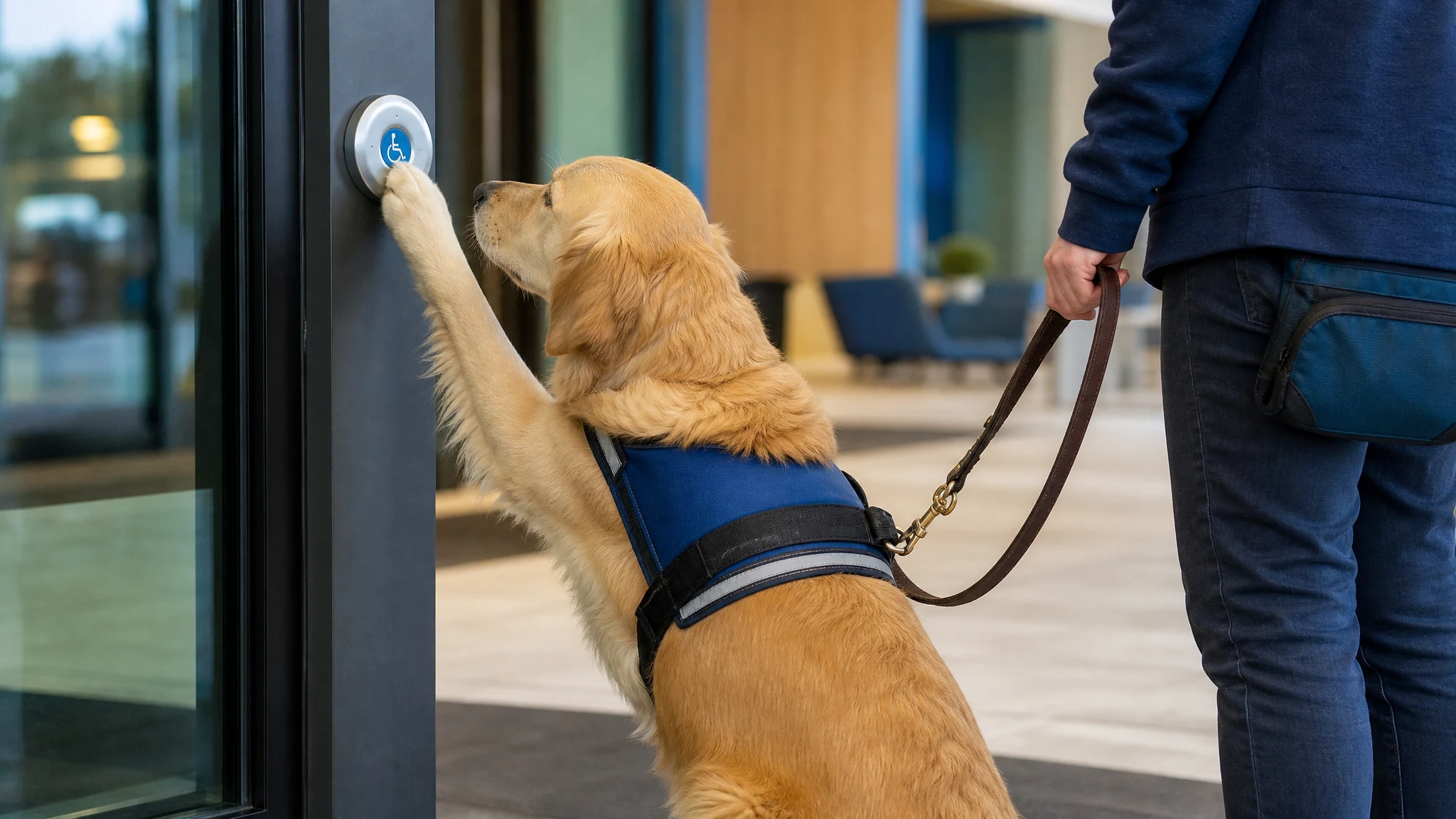
In plain terms, a task is a trained action that helps with a limitation caused by the disability. If the dog does something on cue or in response to a specific sign, and that action directly helps with the disability, it is a task.
Examples of tasks by disability
These are common examples of what people train. They are illustrations, not a complete or official list, and every handler's needs are different.
- Mobility disabilities: retrieving a dropped item, opening or closing a door with a strap, pulling a manual wheelchair on a flat surface, or bracing so a person can stand.
- Hearing loss: alerting the handler to a doorbell, an alarm, or a name being called.
- Vision loss: guiding around obstacles and stopping at curbs or stairs.
- Seizure disorders: staying with the person during a seizure, or getting help in a way that was trained for that household.
- Diabetes or other medical conditions: alerting to a change the dog has been trained to signal, or fetching a medical kit.
- PTSD or other psychiatric disabilities: interrupting a trained pattern such as repetitive scratching, turning on lights in a room on cue, or creating space in a crowd by standing in front of or behind the handler.
- Autism: interrupting a repetitive behavior or preventing a person from bolting into a hazard, based on a trained response.
The Louisiana statute lists types such as hearing dogs, guide dogs, seizure alert dogs, mobility dogs, autism service dogs, dogs that assist during a medical crisis, and service dogs for people including veterans with traumatic brain injury or PTSD. That list is in La. R.S. 46:1952, from the Louisiana State Legislature.
Why comfort alone is not a task
A dog that calms you by being near you is doing something valuable, but being present is not a trained task. Emotional support, therapy and comfort animals are not service animals under the ADA, according to the ADA's definition of a service animal.
The test is whether the dog was trained to do something that responds to the disability. A dog that senses a panic attack on its own and leans on you is showing a natural behavior. A dog that was trained to apply pressure on cue, or to interrupt a specific behavior, is performing a task.
This is a fair line, not a judgment about anyone's need for support. It is simply how the ADA draws the definition.
What You Need Before You Start
You do not need special equipment to begin task training. A basic kit is enough:
- Small, soft, high-value treats, cut to pea size.
- A flat buckle collar or a well-fitted harness, and a standard leash.
- A clicker or a marker word such as "yes" (optional but helpful).
- Props for the task you are teaching, such as a pouch, a pull strap, or a safe object to retrieve.
- A notebook or phone notes to log sessions.
- A helper for practice outings, ideally someone calm who can follow directions.
- A quiet room to begin, with distractions added later.
All training should be reward-based, in line with guidance from the American Veterinary Society of Animal Behavior (AVSAB). Avoid shock, prong or choke collars, alpha rolls, scruffing, or any dominance method. They carry welfare risks and can damage the trust a service dog depends on.
Step-by-Step: Teaching a Service Dog Task
The steps below work for most tasks. The example is retrieving a dropped item, but the same pattern fits many others.
Step 1: Write down exactly what the dog will do
Describe the task in one or two sentences. "When I drop an item and say 'get it,' the dog picks it up and puts it in my hand." A clear target keeps your training consistent and makes it easy to answer the question people may ask you in public (more on that below).
Step 2: Teach the building blocks
Break the task into small pieces. For a retrieve, that means: look at the object, touch it with the nose, take it gently in the mouth, hold it, and release it into your hand. Mark and reward each tiny success.
Step 3: Add the cue
Once the dog does the behavior reliably, say the cue just before it happens. After many repeats, the dog will begin to connect the word with the action. For alert tasks, the "cue" is the real-life trigger, such as a sound or a scent sample, introduced carefully with a qualified trainer's guidance.
Step 4: Build duration, distance and reliability
Ask for a little more each time: a longer hold, a slightly farther object, a different floor surface. Raise only one factor at a time. If the dog struggles, go back to the last easy step.
Step 5: Practice in new places
Dogs do not generalize well. A retrieve that works in the living room may fall apart in a hallway. Practice in several rooms, then the yard, then quiet public spaces, always rewarding generously at first.
Step 6: Practice the task when it really matters
Use the task in daily life as the need comes up, and keep rewarding it. Reliable tasks come from regular, real use, not occasional drills.
Step 7: Keep a training log
Note what you trained, where, and how it went. A log helps you spot patterns, such as a dog who is less reliable after a poor night's sleep or on slick floors.
The Public Access Test, Explained
The public access test is a structured way to check whether a dog behaves well in public. Assistance Dogs International (ADI) is the group most often tied to the standard, and many programs and trainers use a version of it as a benchmark.
It is important to be exact here: a public access test is a training benchmark, not a legal requirement under the ADA. Passing one does not create legal rights, and not taking one does not remove them. For the current ADI standard, check with ADI directly.
What a public access test generally looks at
Versions vary, but they usually cover the same kinds of behavior. Think of them as a checklist for your own practice outings:
- Calm entry and exit: the dog waits at doors and does not pull through them.
- Loose-leash walking: the dog stays near the handler in aisles, around carts and past other people.
- Settling: the dog lies down and stays quiet under a table or beside a seat.
- Ignoring distractions: dropped food, other dogs, loud noises and friendly strangers do not pull the dog away.
- Housebroken behavior: the dog keeps clean in public places.
- No unwanted barking, sniffing or lunging: the dog stays focused on the handler.
- Staying under control: the dog responds to cues even with the handler a short distance away.
- Task performance in public: the dog can do its trained work with people and distractions nearby.
How to use it as a practice plan
- Choose a few items from the list and practice them at home first.
- Visit a quiet public place where dogs are allowed and ask your helper to watch.
- Keep sessions short, 10 to 20 minutes, and end on a success.
- Move up to busier places only when the dog is relaxed in easier ones.
- Take breaks. A tired or stressed dog is not ready to be tested.
If a dog fails an item, that is information, not a verdict. It simply shows what to practice next.
What Louisiana Law Says About Dogs in Public
The training steps above are about building skill. The law is about access. For the legal side in Louisiana, see our guide on service dogs in Louisiana, including training, access rights and where to go with questions.
Here are the points most connected to tasks and public behavior:
- Access: Under La. R.S. 46:1953, a person with a disability has the same right as others to public streets, buildings and public places, with full and equal access to places such as restaurants, hotels, theaters and common carriers, and may be accompanied by a service dog without extra charge. The handler is liable for damage the dog causes.
- The two questions: The same statute says a public entity may ask only whether the dog is required because of a disability and what work or task it is trained to perform. ADA.gov lists the same two questions. They may not ask about the nature or extent of the disability.
- No paperwork required: Louisiana law bars requiring proof of certification, training or licensing (R.S. 46:1953). The ADA has no official service dog registry or required certification either.
- Removal: A public entity may ask that a dog be removed if it is out of control and the handler does not control it, or if it is not housebroken. The person must then be allowed to enter without the dog.
- Dogs in training: Louisiana's definition covers dogs that have been trained or are being trained (R.S. 46:1952). Under R.S. 46:1955, a trainer or puppy raiser has the same rights and privileges as a person with a disability during training, with no extra charge for the dog, and is liable for damage the dog does.
- Misrepresentation: R.S. 46:1975 prohibits misrepresenting an animal as a service dog or service dog in training to a person or entity that owns or operates a public accommodation or residential dwelling.
This is why task clarity matters. Being able to say, in one sentence, what work your dog is trained to do answers the second question simply and honestly. And a dog that is calm and under control is much less likely to be asked to leave.
Tips for Better Results
- Train the task, not the label. Focus on what the dog does for you, not on gear or paperwork.
- Use very small steps. Most training problems come from asking for too much too fast.
- Watch your dog's stress signals. Yawning, lip licking, turning away and a tucked tail mean the dog needs an easier setting.
- Reward calm behavior. Pay the dog for settling, not only for working.
- Plan for rest. Service dogs need downtime, play and exercise like any other dog.
- Ask for help. A qualified positive-reinforcement trainer can help you shape complex tasks. Check any program's current services and fees with the program directly.
Common Mistakes to Avoid
- Counting comfort as a task. Calming presence is lovely, but it does not meet the ADA definition on its own.
- Buying a registration, ID card or certificate. There is no official registry under the ADA, and an online registration is not legal proof of anything. Spend that money on training instead.
- Treating the public access test as a law. It is a benchmark. Use it to guide practice, not to claim or deny rights.
- Rushing into crowded places. Overwhelmed dogs learn to shut down or act out.
- Using harsh corrections. Shock, prong and choke collars, alpha rolls and scruffing are not part of humane service dog training.
- Skipping house training and basic manners. Control and cleanliness are the two reasons the law lets a business ask for removal.
- Ignoring the dog's health and temperament. Not every dog is suited to public work. It is fair and kind to recognize that early.
What Results to Expect
Progress varies a great deal. Many dogs can learn a simple task, such as a retrieve, within weeks of consistent practice, but a reliable task in public places often takes months. Complex or alert-based tasks may take longer, and some dogs may not be a good fit for the work.
With steady, reward-based practice, you may notice your dog responding faster, settling more easily in public and recovering sooner from surprises. Those are good signs, though no training plan can promise a particular outcome.
If Your Rights Are Denied
If someone denies you access in Louisiana, the Louisiana Commission on Human Rights accepts public accommodation complaints. Under R.S. 46:1956, withholding or denying a person with a disability their rights under the chapter, or injuring a service dog, is a misdemeanor, and civil action is also provided. This article states what the law says and is not legal advice, so contact the agency with questions about your situation.
Sources
- ADA.gov, Service Animals FAQ
- Louisiana State Legislature, R.S. 46:1952 Definitions
- Louisiana State Legislature, R.S. 46:1953
- Louisiana State Legislature, R.S. 46:1955 Service dog trainers and puppy raisers
- Louisiana State Legislature, R.S. 46:1956
- Louisiana State Legislature, R.S. 46:1975 and 46:1977
- Louisiana Commission on Human Rights, file a complaint